Saturday, August 27, 2022

Mary Slessor


Mary Slessor

Mary Mitchell Slessor was born in 1848 in Aberdeen, Scotland, one of four surviving children to a poor working-class family.  Her father was a shoemaker and an alcoholic, and unable to consistently provide for their family.  Her mother was a devout Presbyterian who brought income to the family by working as a weaver.  At times, her mother pushed her out of the house into the streets to escape a drunken beating from her father.  While on the streets, she had to fend off drunks.

By the time she was eleven, she was working from 6AM to 6PM in the mills preparing jute and flax for the weavers.  Eager to improve herself, she signed up for night schooling offered by the factory for the child workers.  When she would nod off in class from exhaustion, she would be forced to stand for the lectures as punishment.

She became a Christian when a woman held her hand near a fire and warned her of Hell.  As she grew older, she began holding Bible classes for the poor children in her area – children she shared a background with.  She organized picnics and ‘fun’ days, raising the eyebrows of “proper” Christians by running races with the children.

During this time, a gang of young men tried to intimidate her.  They slung mud at her and mocked her during her teaching.  At one point, they grabbed her and stood her up.  The leader of the gang whirled a lead weight on a string around, getting closer and closer to her face.  Praying inwardly for strength to stand her ground, Mary faced the threat down until the weight grazer her forehead.  Impressed with her courage, the gang leader made all in his group attend her meetings.  “What is courage, but conquering fear?” she later said.

Presbyterians at this time were very missions-minded.  Letters from missionaries were circulated among churches and read aloud during the service.  A monthly magazine was published called the Missionary Record containing the writings and needs of various missionaries around the world.  When the great Dr Livingstone died, Mary was 27 years old and resolved to follow the legendary missionary’s footsteps in Africa.

Mary immediately began laying the groundwork for a missions trip herself, and a year later boarded the S.S. Ethiopia in August of 1876 headed to what is now Nigeria.  Recalling the effects of alcohol on her family, she was distressed to see the main cargo of the ship was large barrels of whiskey.  She remarked, “Scores of barrels of whiskey, and only one missionary.”

In Nigeria, despite having read up on the culture there, she was shocked at the level of depravity and native superstition in her field.  Life meant little – it was nothing to kill a slave, or a child.  The birth of twins to a family was regarded as an evil omen, dealt with by slaughtering the babies and either killing the mother or running her out of the village.  Matters of guilt or innocence were often determined by having the accused eat poisoned berries of seeing if they survived being immersed in burning oil.  The death of a village elder was accompanied by the human sacrifice of his servants so they would accompany him into the afterlife.

Mary, noted among the people there for her bright red hair and bright blue eyes as much as her quick ability to pick up the local languages, had a tremendous impact among the locals.  She was very active in rescuing twins and their mothers, helping them to see their lives had value in the eyes of Christ.  She ministered to the mothers and children, helping them to see their worth in Christ and helped them acquire vocational skills to take care of their children and themselves.  She adopted a number of orphaned children.  At great risk to herself, she spoke against the dehumanizing practices in the culture and worked to change them, village by village.  Fearlessly, she often ventured alone into remote villages to combat the dehumanizing religion of the area, at one point chasing down a group of masked bandits and ripping the mask off the ringleader to demonstrate their weakness.  She played a major role in stopping or preventing outright wars between villages.

She contracted Malaria more than once, having to return to England on occasion where she was a great inspiration to the church.  Earlier sicknesses of Malaria rendered her body weak later in her life, to the point that she had to be pushed in a homemade wheelchair from village to village.

While at a missionary station in early January of 1915, she fainted after hearing the news of Europe at war.  She was revived, but weakened to the point where she died on January 13th of that year, age of 64.

A memorial plaque over her grave in Nigeria reads: “In loving memory of Mary Mitchell Slessor.  For thirty-eight years a heroic and devoted missionary chiefly among the up-river tribes of this land.  The people that walked in darkness have seen a great light.  They that turn many to righteousness shall shine as the stars for ever and ever.”


e-mail from Christian History, 10 January 2021

https://en.wikipedia.org/wiki/Mary_Slessor

https://infomaryslessor.org/page%202.html


Sunday, August 14, 2022

Charles F. Weigle

Dr Charles Weigle, born in Indiana in 1871, was an itinerant evangelist and hymnwriter.  Returning home after a series of meetings, he found a note from his wife.  It read, “I’m leaving, Charlie.  I don’t want to live the life you’re living.  I want to go the other way – toward the bright lights.”  She took their only child, a daughter, with her and filed for divorce.

Charles wandered aimlessly for a period of time, during which he contemplated suicide.  He wondered if anyone could ever care for him again.  Eventually, though, he turned his despair around and resolved to commit himself to living completely for Jesus.  Charles met his ex-wife by chance a few months later, and she mocked him, bragging to him about the sins she was committing.  Two years later, she lay on her deathbed – a result of the life she chose.

A few years later, Charles sat down and contemplated all that God had brought him through.  He thought about how Jesus was there for him, even when he felt abandoned and that nobody could care for him.  He said he wrote these words in the span of about 20 minutes, and wrote the music soon after.

I would love to tell you what I think of Jesus; Since I found in Him a friend so strong and true;
I would tell you how He changed my life completely; He did something that no other friend could do.

(Chorus)
No one ever cared for me like Jesus, There’s no other friend so kind as He;
No one else could take the sin and darkness from me.  O how much He cared for me.


All my life was full of sin when Jesus found me; All my heart was full of misery and woe;
Jesus placed His strong and loving arms around me; And he led me in the way I ought to go.

Every day He comes to me with new assurance; More and more I understand His words of love;
But I’ll never know just why He came to save me; Till some day I see His blessed face above.


Dr Weigel retired to Chattanooga at the age of 80.  He lived near Tennessee Temple Schools, a Bible college, and was active in the lives of young people training for the ministry.  He died in 1966, at the age of 95.  The last time he was seen alive, he was in his office Bible open, making notes in the margins.

https://welovegod.org/guide/charles_frederick_weigle/#:~:text=Charles%20Frederick%20Weigle%201871-1966%20Evangelist%20and%20Gospel%20songwriter.,training%20that%20later%20helped%20him%20in%20his%20ministry.

https://www.wayoflife.org/reports/conversion_of_charles_weigle.html


Saturday, July 16, 2022

Welch's Grape Juice

Thomas Bramwell Welch was born in England on the last day of 1825.  He emigrated to America with his parents at age 8.  As a teenaged young man, he became a staunch Wesleyan Methodist and heavily involved in the two social issues predominant in his day: temperance and abolition.  Throughout his late teen years, he was involved in the Underground Railroad, the transporting of escaped slaves surreptitiously into Canada.

Thomas graduated from a Wesleyan seminary at age 19 and became an ordained minister.  He served his church for a few years until his voice failed.  He went back to college and took up the profession of dentistry, but remained an active church member.

Wesleyans, as a number of denominations of the day, were Temperance-minded – prohibiting the manufacture, sale, or consumption of any intoxicating liquor.  A number of churches recognized the appearance of hypocrisy in offering fermented wine during the rite of the Lord’s Supper.  Welch’s denomination addressed this by mandating that only non-fermented grape juice be used in Communion.

This presented an issue – as pasteurization had not yet been invented and non-pasteurized grape juice naturally ferments when stored at rom temperature.  Individual churches took a variety of approaches to meet this requirement.  Some churches squeezed their own grapes during the week and would serve the juice before it had a chance to ferment.  The problem with this was that not all churches had a ready supply of grapes.  Others would pound raisins to a pulp and mix the pulp with boiling water – making their own “wine.”  Some churches did not offer Communion unless grapes were available to be freshly squeezed.  Other churches used water in place of the wine – using Jesus’ miracle of turning water to wine as Scriptural justification.

A staunch Temperamentalist, as well as a godly man who wanted to obey God’s word in all things, Dr. Welch pushed his own church in Vineland, New Jersey, to use unfermented grape juice.  After reading about the new process of pasteurization, Welch experimented with ways to apply the technique to grape juice – with the intent of supplying churches with an alcohol-free substitute for Communion.  For four years, he tried to sell what he marketed as “Dr Welch’s Unfermented Wine” to churches.  Unfortunately for him, the idea didn’t evolve into a sustainable business model and he had to give up his side business.

Two years later, Thomas’ son Charles – also a dentist – encouraged his father to try again with an expanded reach.  He published advertisements in Temperance magazines and offered samples to churches, marketing the product as “unfermented wine” and “the kind [of wine] that was used in Galilee.”  He later marketed the product as a health tonic.  The business took off when it samples were given out at the World’s Fair in Chicago in 1893. 

Today, Welch’s is a multinational corporation offering many products.  It began, however, with the desire of a godly man to give his church an alternative to fermented wine during the Lord’s Supper.  In Charles Welch’s will he wrote, “Unfermented grape juice was born in 1869 out of a passion to serve God by helping His Church to give its communion the ‘fruit of the vine,’ instead of ‘the cup of devils.’”

https://www.umc.org/en/content/communion-and-welchs-grape-juice

https://en.wikipedia.org/wiki/Thomas_Bramwell_Welch


Saturday, June 11, 2022

Krishna Pal


Krishna Pal

On the last Sunday of 1800, a thirty-six year old Indian carpenter named Krishna Pal was baptized by the missionary William Carey.  He was the first convert after seven years of labor by the famed missionary.

A devout Hindu, he tried tirelessly to perform the works he understood to be necessary for Hinduism: worshiping idols, bathing in the Ganges River, making pilgrimages to holy places, licking the dust from his guru’s feet, giving property to priests, repeating the name of his guardian deity, and meditating on and singing Hindu verses.  Despite being persistent in his Hindu practices, the dread of his sin hung over his head and he lived in fear.

While performing one of the bathing rituals of Hinduism, Pal dislocated his arm.  In pain, he went to the mission hospital where Carey’s associate Dr. John Thomas reset his arm.  During his treatment, the staff witnessed to him about Christ and Pal, intrigued, found more reasons to visit the mission house.  Coming to an awareness of his own sin, he wept and came to faith.  During his baptism, in front of many Hindu witnesses, he proclaimed, “I tried the Hindu worship, but got no good…After a while I heard of Christ – that He was incarnate, labored much, and at last laid down His life for sinners.  I thought, ‘What love is this!’  And here I made my resting place.” 

India had (and still has) a caste system.  Pal immediately gave up his high caste to dine with the missionaries.  This, more than anything else, drew the attention of his countrymen.  He reasoned, “The man who keeps his caste cannot obtain salvation.  Men who have their caste are very proud, and he who is proud cannot enter into the kingdom of God.”

During his baptism, Carey said to the assembled crowd, “Ye gods of stone and clay, did ye not tremble when, in the name of the Father, Son and Holy Ghost, one individual shook you as the dust from his feet?”  Pal’s wife later followed him in baptism as did others in his family.  They were the first fruits of Carey’s ministry.  He was kicked out of his house, robbed, and persecuted.  Despite these difficulties, he persisted in his faith, developed a burden for his lost countrymen, and was ordained to the ministry by Carey in 1804. 

Krishna Pal traveled from one end of India to the other preaching and sharing his faith with all the nationalities he could in India.  He was so energetic in his witness that an associate of William Carey’s later remarked that of the churches in India in his day that most were begun initially through the influence of Pal.  He authored a number of Christian hymns popular among Indian Christians in his day, including “O Thou My Soul, Forget No More.”

O thou, my soul, forget no more

The Friend Who all thy misery bore;
Let every idol be forgot,
But, O my soul, forget Him not.

Jesus for thou a body takes,
Thy guilt assumes, thy fetters breaks,
Discharging all thy dreadful debt;
And canst thou e’er such love forget?

Renounce thy works and ways, with grief,

And fly to this most sure relief;
Nor Him forget, who left His throne,
And for thy life gave up His own.

Infinite truth and mercy shine,
In Him, and He Himself is thine:
And canst thou, then, with sin beset,
Such charms, such matchless charms, forget?

Ah! no—till life itself depart,
His Name shall cheer and warm my heart;
And lisping this, from earth I’ll rise;
And join the chorus of the skies.

Ah! no—when all things else expire,
And perish in the general fire,
This name all others shall survive,
And through eternity shall live.

In August of 1822, Krishna Pal contracted Cholera and died – an enthusiastic servant of his Lord.


e-mail from Christian History, 28 Dec 2020

https://www.evangelical-times.org/krishna-pal/

https://www.crichbaptist.org/krishna-pal/


Sunday, May 22, 2022

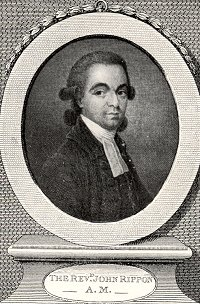
John Rippon - How Firm a Foundation

John Rippon

John Rippon came to Christ at age 17, in the year 1768.  He entered Bristol Baptist College in England and, upon graduation at age 21, he was called by a church whose long-serving pastor had passed away, a very respected author and preacher named John Gill.  When he came to interview, the church extended the call to him but 40 families were turned off by his youth and left to form their own congregation…eventually calling a 19-year-old man as their pastor.  John did not let the bad blood fester, even participating in the consecration of that young pastor.  He even encouraged his own congregation to contribute funds to the building of the breakaway church’s new sanctuary.  Because of Rippon’s humility and good humor, the two churches became close and worked together for the cause of Christ.

Rippon was less of a scholar than his predecessor, but an impassioned pastor to his flock with a strong burden for the lost.  His London church, called Carter Lane Baptist Church, experienced great growth during his 63-year tenure at that church, Pastor Rippon serving until his death in 1836, having baptized over 900 people.

John Rippon was an author and editor.  He edited a publication called ‘The Baptist Annual Register’ – a compilation of Baptist writings from England and North America on missions, business, associations, notices of books and articles by Baptist scholars, obituaries, and any other item he deemed of interest to English-speaking Baptists.  Baptist historians today are greatly indebted to his work.  He also wrote a selection of hymns which he intended to complement the incredible works of Isaac Watts.  His  most notable being ‘How Firm a Foundation’.

                How firm a foundation, ye saints of the Lord,
                Is laid for your faith in His excellent Word!
                What more can He say than to you He hath said,
                To you who for refuge to Jesus have fled?

In his latter years, Rippon would often pray for God to raise up a young man to lead his church to bigger and greater things.  Many people see the answer to his prayers in the man who took over his church almost 20 years after his death and later moved the place of meeting and renamed it ‘The Metropolitan Tabernacle’ – the ‘Prince of Preachers’ Charles Spurgeon, who was 19 years old at the time of his calling.  Spurgeon, later writing the history of the Metropolitan Tabernacle, characterized Rippon and his ministry as, “Beloved at home, respected abroad, and useful everywhere.”

https://en.wikipedia.org/wiki/John_Rippon

https://hymnary.org/person/Rippon_J

https://www.tribune.org/john-rippon-63-years-a-london-pastor/


Saturday, May 14, 2022

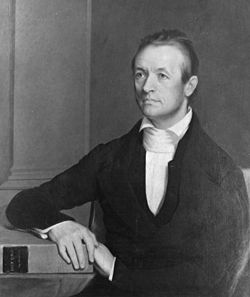
Adoniram Judson, America's first foreign missionary

Adoniram Judson, America’s first foreign missionary

Adoniram Judson Jr. was born to a Congregational minister in Massachusetts in 1788.  As a young man, while in attendance at Brown University, he met a friend named Jacob Eames who introduced him to the writings of the new atheistic French philosophies.  Breaking his parents’ hearts, he abandoned the faith he was raised with and embraced his newfound atheism.  He made his home in New York where he taught at a school and wrote math and grammar textbooks for girls’ schools.

Eventually tiring of New York, he decided to set off for the West.  While traveling he came, utterly exhausted, late one evening to an inn.  Inquiring about a room, Adoniram was told there were none available.  When he pressed the innkeeper, he was told that they could make room if he was willing to share a room with a man who was deathly ill.  He readily agreed and the innkeeper hung a sheet to allow for some privacy for both parties.  Tired as he was, Adoniram was kept up most of the night by the wails of the sick man and the constant rushing footsteps of his caregivers.  It was only early in the morning that Judson dropped to sleep, in sheer exhaustion.

While settling his debt with the innkeeper the next morning, Adoniram inquired about his roommate.  The innkeeper replied that the man had sadly died during the night.  Judson asked his name and received the reply, “Jacob Eames.”  Hearing the name of his former friend, the man who had led him away from his faith, shook Adoniram to the core.  If his friend, who supposedly had all the answers, had died so miserably, what hope was there for him?  Judson returned to his faith, enrolled in Andover Theological Seminary, and decided on a missionary career.

In 1812, two weeks after marriage to Ann Hasseltine, Judson was commissioned by the Congregational Church and set off for India, hoping to parallel the missions work of William Carey among the natives there.  While en route, though, he did a study on baptism and came to the conclusion that his denomination’s views on baptism were incorrect.  He came to the conclusion that a part of the Great Commission (Matthew 28:19-20) included believer’s baptism (as opposed to the infant baptism of the Congregationalists).  When he arrived in Calcutta, both he and Ann were baptized by immersion.

This new belief would certainly cause an issue with his sending denomination.  The ship, returning to the United States, carried two letters from Judson.  The first was a letter to the Congregational sending board, resigning his position.  The second was a letter to the newly-formed American Baptist association, informing them he was available for support.  His letter was the impetus for American Baptists to form their own missions organization and they replied in the affirmative.

Political upheaval caused by the war of 1812 resulted in the Judsons’ being forced out of India.  In July of 1813 they moved to Burma, and Ann miscarried her first child en route on board the ship.  Judson knew Greek, Hebrew, and Latin, in addition to English, but spent a full three years, twelve hours a day, learning the Burmese language before he was comfortable preaching to the people – time they spent with minimal contact with the outside world.  During this time, their second child also died at eight months of age.

Judson’s goal was “to preach the Gospel, not anti-Buddhism.”  By 1819, five years after arrival, Adoniram had his first convert.  By 1823 there were 18 believers – after a full ten years of missions labor.  He had completed by this time a Burmese Grammar and had begun to translate the Bible into Burmese.  Adoniram requested and was eventually sent a printing press, with which he printed copies of the Gospel of Matthew and Christian tracts.  Ann had picked up the language as well as her husband, perhaps better, and had developed loving friendships with many of the local women.

There was a race of people in Burma called the Karen.  They were animistic peasants and were considered to be an inferior people by other Burmese.  It was said, “You can teach a buffalo, but not a Karen.”  Adoniram took a young Karen with a criminal record under his wing and, after nearly a year of teaching and gentle instruction, this young man named Ko Tha Byu came to faith.  As Adoniram preached in different areas, Ko Tha Byu would speak to the peasant Karen.  As a result of the young man’s preaching, entire families and villages of Karen came to faith, and they later became a dynamic source of missionaries reaching other Burmese.  The number of Karen Christians today number in the hundreds of thousands.

The British went to war with the Burmese in 1826.  As a Westerner, Adoniram was imprisoned with other Western men in brutal conditions.  Often not fed, constantly shackled in irons, and sometimes suspended by his feet in chains with only his head and shoulders touching the ground, he suffered miserably for 21 months.  Ann was the model of supreme courage during this time.  As a Western woman, alone in a country at war with the West, she gave birth to her third child and went from official to official pleading for her husband’s release, and visiting him when she was able.  Unfortunately, soon after his release, Ann died from her exertions, and their child died six months later.  Several months later, the Burmese government compelled him to serve as translator for them with the victorious British to negotiate terms of their defeat.

For a year after Ann’s death, Adoniram suffered from a crippling depression.  Fellow missionaries, George and Sarah Boardman, lifted his spirits and he continued and eventually completed his translation work of the Bible into Burmese – a translation still in use today.  He first published it in 1835, after 24 years of work.

That same year, 1835, Adoniram married Sarah Boardman, who had become widowed.  They had eight children, five of whom survived to adulthood.  In 1845, Sarah took ill and doctors prescribed rest and a trip home.  She died in route.

Upon his return to America, Adoniram Judson was unexpectedly treated as a celebrity.  He toured the Eastern United States, speaking and raising money for foreign missions.  His own illness kept him from speaking loudly, so he needed an “Aaron” to speak for him.  He found he had difficulty conversing in English, since so much of his life was invested in the Burmese language.

While in the United States, he married for the third time, to a poet named Emily Chubbuck, 29 years his junior.  They returned to the mission field in 1846, where Adoniram died in 1861. 

Judson’s legacy is multi-faceted.  His impetus led to the creation of the American Baptist Missionary Society, the predecessor of our own Southern Baptist International Missions Board (IMB).  He published the first Burmese Bible, which remains the most widely read Bible in that language today.  Ann wrote many letters about missions life which inspired many generations of women to go into missions themselves.


https://en.wikipedia.org/wiki/Adoniram_Judson

https://en.wikipedia.org/wiki/Emily_Chubbuck

Bailey, Faith, Adoniram Judson, Moody Press, 1955.

McGavran, Donald A., The Bridges of God, in Perspectives on the World Christian Movement, A Reader, 2009.

Saturday, April 9, 2022

Hossein Soodmand, Martyr for Christ


Hossein Soodmand – Iranian martyr for Christ

Hossein Soodmand was born in Iran to a devout Muslim family and, while growing up, was taught to hate Christians.  When he was seven years old, he was taunting and throwing stones trying to break the water pitcher of a Christian woman in his village.  When the pitcher broke, he turned to run but tripped and fell, cutting open his knee.  When he saw the woman coming toward him, he feared a beating but was shocked when she cleaned and bandaged his wound and gave him a sweet treat.  His daughter later recalled that he never forgot her “unusual display of mercy and grace.”

As a young man, he was drafted into military service.  He took very ill and was transported to a hospital where an Armenian Christian cared for him, giving him a small cross and praying for him.  Hossein fell asleep and had an intense dream in which he remembered Jesus giving him something to eat.  When Hossein woke up, he was completely healed.

After leaving army service, he moved to the town of Ahvaz, where he sought out a group of Christians and came to faith – determined to serve the Savior who had healed him.  Christianity was not yet illegal, though certainly frowned upon, as this was before the 1979 Islamic Revolution when the Shah was deposed and the Ayatollah Khomeini rose to power.  He was, as with many Muslim converts, ostracized by his family for his newfound faith.  He spent some time doing Christian work in a school for the blind, and met his wife Mahtab there, one of the students of the school.  They had four children together and he pastored his children as lovingly as he pastored his flock.

By the time of the Islamic Revolution, Hossein had become a pastor under the Assembly of God denomination and had moved back to his hometown of Mashhad where he had established a growing church in the basement of his house. 

Hossein’s daughter, Rashin, later remembered that, when she was eleven years old, her father was arrested for the first time.  He spent a month in prison and was released with the threat of execution if he didn’t renounce his faith.  The authorities in his church offered him the opportunity to escape the country and he replied, “I am a follower of the great Shepherd of the sheep, our Lord Jesus Christ, and I am ready to sacrifice my soul for my sheep.  For me to escape from this persecution would cause the hearts of my flock to become cold and weak.   And I never want to be a bad example for them.  So, I am ready to go to prison again and, if necessary, to give my life.” 

His house church continued until his re-arrest in 1990.  He was placed into solitary confinement and later hanged for the crime of apostasy on December 3rd of that year – the trial and execution were something his family didn’t find out about until after the fact.  Hossein was buried in an unmarked grave in the area of the cemetery reserved for the accursed.  Having the opportunity to visit his grave 29 years later in 2019, the family found the area had been bulldozed as part of a planned expansion of the cemetery.  Nobody would tell them if his body had been exhumed.

Hossein’s son Ramtin became a pastor and Iranian Evangelical leader in his father’s stead before he was arrested in 2008 for the crime of apostasy.  A huge international outcry and the intervention of Amnesty International secured his release and safety for his family. 

His daughter Rashin currently lives in London, England, and continues the evangelistic work of her father and speaks publicly about the persecution of Christians in Iran.  She has a fantastic interview on YouTube on the Voice of the Martyrs page.

Pastor Hossein Soodmand remains the last person formally executed under Iran’s anti-apostasy laws.  A number of people remain under a death sentence in Iran, including a few directly tied to Pastor Soodmand, but Iran has become very sensitive to international pressure following Hossein’s death.  His martyrdom in one of the most hostile areas in the world to the Gospel remains a source of inspiration and comfort to Iranian Christians worldwide.


https://www.youtube.com/watch?v=BJfu5BJJe5U

https://www.youtube.com/watch?v=K_zjbwbmhE4

https://www.christianpost.com/news/iran-bulldozes-over-grave-of-pastor-executed-for-converting-to-christianity-after-seeing-jesus-in-dream.html

https://www.christiantoday.com/article/iranian.authorities.release.son.of.hanged.pastor/21739.htm

https://www.executedtoday.com/tag/ramtin-soodmand/