Showing posts with label hymn. Show all posts

Saturday, August 23, 2025

Blest Be the Tie That Binds


John Fawcett was born in England, near Yorkshire, in 1739.  Orphaned at the age of twelve, he apprenticed under a tailor.  As a sixteen-year-old young man, he came to faith under the preaching of George Whitfield.  After a few years as a Methodist, he became a Baptist and felt God’s call to preach. 

Largely self-educated, he became the pastor of a Baptist church in a little town called Wainsgate in 1765.  For seven years he stayed with that little congregation and the miniscule salary they could afford to pay him.  With a growing family and a small salary, it made sense to move when a call came from a much larger Baptist church in London. 

Moving day came.  Men, women, and children of the little congregation helped the young family pack and load crates onto wagons.  Noticing the tears and the grief of the parishioners at losing their beloved pastor John’s wife pulled him to the side and told him, “I cannot bear to leave.  How can we go?”  John confessed to her that he had the same feelings.  Abruptly, he told the men to unload the wagons.

John ministered to the little church in Wainsgate for 54 years, until his death in 1817.  The little congregation never could afford to pay him more than the equivalent of $200 per year, a salary he had to supplement with teaching.  Nevertheless, John Fawcett’s love for his flock compelled him to sacrifice the more prestigious pulpit and stay.  Taking up writing, John published many hymns, volumes of poetry, and theological works.  John often wrote special songs for his congregation, meant to be sung after the sermon as a closing to their time of worship and fellowship together.  The most famous of these was written after his decision to stay at Wainsgate:


Blest be the tie that binds; Our hearts in Christian love;
The fellowship of kindred minds is like to that above.

Before our Father's throne; We pour our ardent prayers;
Our fears, our hopes, our aims are one; Our comforts and our cares.

When we asunder part; It gives us inward pain;
But we shall still be joined in heart; And hope to meet again.


https://hymnary.org/person/Fawcett_John1740

https://web.archive.org/web/20090213115457/http://www.christianitytoday.com/tc/2008/002/12.11.html

https://www.ccel.org/ccel/nutter/hymnwriters.FawcettJ.html


Sunday, August 10, 2025

Got Be With You Til' We Meet Again


The hymn “God Be With You Til’ We Meet Again” was written by Rev Jeremiah Rankin in 1880, pastor of Washington DC’s First Congregational Church and President of Howard University.  He wrote it after discovering that the term “good-bye” meant “God be with you.”

On September 19th, 1945, Darlene Deibler was liberated from a Japanese prison camp – just a few days after Japan signed their surrender aboard the USS Missouri.  Eight years before, she and her new husband had landed in New Guinea along with a mentor, Dr Robert Jaffray as missionaries.  Now, both her husband and her mentor were dead and Darlene, a 28-year-old widow, was returning home without a single thing to her name.

In prison, she had suffered in indescribable ways, both mentally and physically.  She had suffered from exhaustion, starvation, malaria, beriberi, and dysentery.  She had witnessed death on a horrible scale.  During this time, not one letter or package had reached her.  She wrote that as she departed, she prayed a bitter prayer, “Lord, I’ll never come to these islands again.  They’ve robbed me of everything that was most dear to me.”

Suddenly, she heard voices being raised in the distance.  On the shore were a large number of believers, most of whom had come to know Jesus through their mission.  They were singing, “God be with you til’ we meet again.  By His counsels guide, uphold you.  With His sheep securely fold you.  God be with you til’ we meet again.”

In her autobiography Evidence Not Seen she wrote, “This song released the waters of bitterness that had flooded my soul, and the hurt began to drain from me as my tears flowed in a steady stream.  The healing had begun.  I knew then that some day, God only knew when, I would come back to these people and my island home.”


God be with you til’ we meet again; By His counsels guide, uphold you.

With His sheep securely fold you; God be with you til’ we meet again.


Til’ we meet, til’ we meet, Til’ we meet at Jesus feet,

Til’ we meet, til’ we meet.  God be with you til’ we meet again.


God be with you til’ we meet again; ‘Neath His wings protecting hide you.

Daily manna still provide you; God be with you til’ we meet again.


God be with you til’ we meet again; Keep love’s banner floating o’er you.

Smite death’s threatening wave before you; God be with you til’ we meet again.


God be with you til’ we meet again; When life’s perils thick confound you.

Put His arms unfailing ‘round you; God be with you til’ we meet again.


Morgan, Robert J., Then Sings My Soul, Thomas Nelson Publishers, 2003.


Saturday, July 26, 2025

Day By Day


Karolina Wilhelmina Sandell-Berg was born in Sweden in 1832, the daughter of a Lutheran pastor.  Very much a “Daddy’s girl”, she loved and adored her father. 

At an early age Lina (pronounced with a long ‘i’) was stricken with a paralysis that confined her to bed most of the time.  Doctors pronounced her case to be hopeless, but her parents prayed devotedly for her recovery.  One Sunday morning, while her parents were in church, Lina began reading the Bible and praying in earnest.  When her parents returned, they found their 12-year-old daughter dressed and walking around the house – completely recovered.

After her experience of healing, Lina poured out her love for God into verse, publishing her first book of poetry expressing her love for God by the age of 16.

At the age of 26, Lina experienced a tragedy which affected the course of her life.  With her father in a boat crossing a lake, the boat suddenly lurched and her beloved father was thrown overboard and drowned right in front of her eyes.  Nine years later, then married to a merchant and future member of the Swedish Parliament (Oscar Berg), she lost her only child at childbirth.

Lina poured her grief into her poetry, her broken heart spurring her to write more.  With many of her poems, over 650 of them, being set to music, she is often referred to as the Fanny Crosby of Sweden.  Her hymns were a tremendous influence of the great revival in Scandinavia in the 1850s. 

One of her hymns that has been translated to English is Day by Day:

Day by day and with each passing moment, Strength I find to meet my trials here;
Trusting in my Father’s wise bestowment, I’ve no cause for worry or for fear.
He whose heart is kind beyond all measure, Gives unto each day what He deems best –
Lovingly, its part of pain and pleasure, Mingling toil with peace and rest.

Every day the Lord Himself is near me, With a special mercy for each hour;
All my cares He fain would bear and cheer me, He whose name is Counsellor and Pow’r.
The protection of His child and treasure Is a charge that on Himself He laid;
“As your days, your strength shall be in measure,” This the pledge to me He made.

Help me then in ev’ry tribulation So to trust Your promises O Lord,
That I lose not faith’s sweet consolation, Offered me within Your holy Word.
Help me, Lord, when toil and trouble meeting, E’er to take, as from a father’s hand,
One by one, the days the moments fleeting, ‘Till I reach the promised land.


Christian History e-mail, 27 July 2025

https://en.wikipedia.org/wiki/Lina_Sandell

https://www.christianity.com/church/church-history/timeline/1801-1900/lina-sandell-berg-songs-out-of-tragedy-11630417.html

https://www.godtube.com/popular-hymns/day-by-day-and-with-each-passing-moment/


Saturday, June 14, 2025

A Mighty Fortress is our God

 A Mighty Fortress is our God

The name of Martin Luther is rightly associated with Theology and Reformation.  He was also a man who moved mightily to reform worship within the church, writing a number of hymns.  Trained as a young man in the flute and singing in the choir, he had a heart and a head for music.  He worked hard to revive congregational singing, often borrowing tunes from secular music, and sometimes feeling later compelled to “give that music back to the devil” because it was too closely associated with bars and taverns.

He once wrote, “Next to the Word of God, the noble art of music is the greatest treasure in the world…A person who…does not regard music as a marvelous creation of God…does not deserve to be called a human being; he should be permitted to hear nothing but the braying of [donkeys] and the grunting of hogs.”

Often in times of difficulty, Martin would turn to Philip Melanchthon, a trusted friend, and sing with him a hymn which has become Martin’s most popular and enduring hymn.  A hymn based entirely on the 46th Psalm.  “God is our refuge and strength, a very present help in trouble.” (Psalm 46:1).


A mighty fortress is our God.  A bulwark never failing.

Our helper He amid the flood, Of mortal ills prevailing.

For still our ancient foe,  Doth seek to work us woe –

His craft and power are great, And armed with cruel hate, On earth is not his equal.


Did we in our own strength confide.  Our striving would be losing.

Were not the right man on our side, The man of God’s own choosing.

Dost ask who that may be?  Christ Jesus, it is He –

Lord Sab-a-oth His name, From age to age the same, And He must win the battle.


And though this world with devils filled, Should threaten to undo us.

We will not fear, for God hath willed, His truth to triumph through us

The prince of darkness grim, We tremble not for him –

His rage we can endure, For lo, his doom is sure, One little word shall fell him.


That word above all earthly powers, No thanks to them abideth.

The Spirit and the gifts are ours,  Through Him who with us sideth.

Let goods and kindred go, This mortal life also –

The body they may kill, God’s truth abideth still; His kingdom is forever.


Morgan, Robert J, Then Sings My Soul, Thomas Nelson Publishers, 2003.


Saturday, March 15, 2025

George Matheson

George Matheson

Born in Glasgow, Scotland, in 1842, he came to faith at an early age and committed his life to Christ’s service.  Attending university at age 20, he began gradually losing his eyesight until he was completely blind.  The care of his sisters, who read his lessons to him and even learned Greek and Hebrew to help him study, were a tremendous help to him.

He was engaged but his fiancĂ©e, overwhelmed with the thought of caring for a blind husband, broke off the engagement.  He never married.

George became a minister in the Church of Scotland and was called to pastor churches in Innelan and Edinburgh.  His tremendous ability to memorize large portions of Scripture and his sermons made many of his hearers not realize he was blind at all. 

George composed many hymns, and even authored a hymnal.  A natural scholar, he wrote books and papers on many topics, some spiritual, some secular, including works on the intersection of science and Scripture – related to the new evolutionary theories of Darwin. 

He authored the hymn O Love That Will Not Let Me Go - #292 in our Baptist Hymnal.  On the evening of June 6th, 1882, on the occasion of his sister’s wedding, he suffered great mental stress.  Alone in the place he was staying, he wrote:

“Something happened to me, which was known only to myself, and which caused me the most severe mental suffering.  The hymn was the fruit of that suffering.

“It was the quickest bit of work I ever did in my life.  I had the impression of having it dictated to me by some inward voice rather than of working it out myself.  I am quite sure that the whole work was completed in five minutes, and equally sure that it never received at my hands any retouching or correction. I have no natural gift of rhythm. All the other verses I have ever written are manufactured articles; this came like a dayspring from on high.”

George died of a sudden stroke in 1906.  He is buried next to his parents in Glasgow.

https://en.wikipedia.org/wiki/George_Matheson

https://www.christiantoday.com/news/o-love-that-wilt-not-let-me-go-how-a-blind-pastor-produced-a-work-of-genius

https://www.blueletterbible.org/hymns/bios/bio_m_a_matheson_g.cfm


Sunday, March 2, 2025

It Is Well With My Soul

On October 8th, 1871, Mrs O’Leary’s cow kicked over a lantern and started the Great Chicago Fire.  This devastating fire lasted three days, destroyed over 3 square miles of the city, including over 17,000 structures, killed about 300 people and left over 100,000 residents homeless.

Horatio Spafford, a Presbyterian church elder, a friend of D.L. Moody, and a godly man was affected by this tragedy.  A lawyer by trade, he lost much of his financial investments in the fire.  Despite the setbacks, he, his wife Anna, and their four daughters Annie (age 12), Maggie (age 7), Bessie (age 4) and Tanetta (age 18 months) poured their lives into ministering to the victims of this disaster.

After two years of work, the family decided to visit friends in England for a respite.  Anna went ahead with the girls while Horatio stayed behind to wrap up some business.  On November 22nd, 1873, en route to England, the steamship Ville du Havre on which they were passengers was struck by another vessel, with great loss of life.  Anxiously, Horatio awaited news.  He eventually received a telegram from his wife with two words, “Saved, alone.”

Immediately, Spafford traveled to England to be with his grieving wife.  En route, he asked the ship’s captain to notify him when they reached the place where his daughters were lost.  When word came to him, Horatio went up on deck and penned the words to a beloved hymn:

When peace, like a river, attendeth my way.

When sorrows like sea billows roll.

Whatever my lot, Thou hast taught me to say,

“It is well, it is well with my soul.”


It is well (it is well),

With my soul (with my soul),

It is well, it is well with my soul.


Though Satan should buffet, though trials should come,

Lest this blest assurance control,

That Christ hath regarded my helpless estate,

And hath shed His own blood for my soul.


My sin, oh the bliss of this glorious thought!

My sin, not in part but the whole,

Is nailed to the cross, and I bear it no mare,

Praise the Lord, praise the Lord, O my soul!


And Lord haste the day, when the faith shall be sight,

The clouds be rolled back as a scroll;

The trump shall resound, and the Lord shall descend,

Even so, it is well with my soul.


Following this tragedy, Anna gave birth to three more children, Horatio, Bertha, and Grace.  In 1881, they moved to Jerusalem and became part of an American Christian colony there, focused on ministry to people of all backgrounds.  There, they adopted a teenager named Jacob.


Horatio Spafford died of Malaria in 1888, age 59.  He is buried in Jerusalem.


https://en.wikipedia.org/wiki/Horatio_Spafford

https://en.wikipedia.org/wiki/Great_Chicago_Fire


Saturday, October 19, 2024

Stand Up, Stand Up for Jesus

Stand Up, Stand up for Jesus

Episcopal Reverend Dudley Tyng was forced to resign from his pastorate in Philadelphia for preaching forcefully against slavery.  Undaunted, he became a Presbyterian and planted a church in his home town.  In addition to his church plant Dudley, along with other ministers, preached at the local YMCA to young men and were used by God to spark a revival of thousands in the city.

In March of 1858, the thirty-three-year-old Tyng preached a sermon to about 5,000 young men in the YMCA hall where over a thousand made professions of faith.  During his sermon he remarked, “I would rather that [my] right arm were amputated at the trunk than that I should come short of my duty to you in delivering God’s message.”

That week, Reverend Tyng went to visit a local farm where he saw a mule-powered corn-shelling machine.  As he reached out to pat one of the mules, the sleeve of his coat caught in the gears and his arm was quickly pulled in to the machine.  The injury was severe and his arm was amputated.

Infection set in and it soon became clear that Dudley was going to die.  His friend and fellow preacher Pastor George Duffield was at his bedside and asked him if he had any message for the men in the city.  “Tell them to stand up for Jesus,” he replied.

Duffield preached the funeral sermon for his friend Dudley Tyng.  He used as his text Ephesians 6:14, “Stand, therefore, having your loins girt about with truth, and having on the breastplate of righteousness.”  He closed his sermon by having a hymn he wrote sung, a hymn based on his friend’s final words to him:


Stand up, stand up for Jesus, Ye soldiers of the cross;

Lift high His royal banner, It must not suffer loss:

From victory unto victory His army shall He lead,

Till every foe is vanquished, And Christ is Lord indeed.


Stand up, stand up for Jesus, The trumpet call obey;

Forth to the mighty conflict, In this His glorious day:

Ye who are men, now serve Him Against unnumbered foes;

Let courage rise with danger, And strength to strength oppose.


[note the allusion to Dudley Tyng’s injury]

Stand up, stand up for Jesus, Stand in His strength alone;

The arm of flesh will fail you, Ye dare not trust your own:

Put on the gospel armor, Each piece put on with prayer;

Where duty calls, or danger, Be never wanting there.


Stand up, stand up for Jesus, The strife will not be long;

This day the noise of battle, The next, the victor’s song:

To him who overcometh A crown of life shall be;

He, with the King of glory, Shall reign eternally.


[the fifth stanza, omitted from most hymnals today, allude to Tyng’s death in the third line]

Stand up, stand up for Jesus, Each soldier to his post;

Close up the broken column, And shout through all the host:

Make good the loss so heavy, In those that still remain,

And prove to all around you That death itself is gain!


https://wordwisebiblestudies.com/the-strange-case-of-dudley-tyng-stand-up-stand-up-for-jesus/

https://www.hymncharts.com/2015/07/27/the-unusual-story-behind-stand-up-stand-up-for-jesus/

https://www.umcdiscipleship.org/resources/history-of-hymns-stand-up-stand-up-for-jesus


Saturday, August 10, 2024

Martin Rinkart


The Thirty Years’ War (1618-1648) was the most destructive war ever fought in Germany, including the two World Wars.  While a lot of political drama added to the tinder, the main conflict was between the fragmented Catholic states of the Holy Roman Empire and the various Protestant states.  The war began when Ferdinand II, the Holy Roman Emperor, made moves to conquer the various Protestant states in Bohemia, precipitating this deadly conflict which eventually drew in most of the states in Europe, including Denmark, Sweden, and France.  Complex alliances were formed: the Catholics in France supported the Protestants in Germany, the Swedes and Danes allied with the Lutherans, Spain sided with the Emperor, France got involved to weaken their rival Spain.

Eilenburg, in today’s Eastern Germany, was a walled city and therefore a refuge for war-displaced people.  As soldiers from each side came through, they compelled the citizens of Eilenburg to quarter and provision them.  As you can imagine, food was scarce and times were very hard.

When the Thirty Years’ War began Eilenburg had a new pastor, Martin Rinkart.  Martin did his very best to tend to his flock as well as provide for his young family.  Overcrowding and hunger led to plague in 1637.  Of the four pastors in Eilenburg one fled and two others succumbed to disease, leaving Martin the sole pastor for the town.  In addition to giving spiritual counsel, he performed as many as 50 funerals a day, including that of his wife.  At times, large trenches were dug for mass burials.  Over 8,000 died in the city.  Following the plague came famine.

In the midst of this famine the Swedish army returned in 1639, demanding 300,000 florins (roughly $2-3M) as a tribute.  Rinkart, now the leading spokesman for the city, spoke with the General requesting they lower their demands.  Up the general’s refusal, Martin returned to the town and addressed the survivors saying, “Come, my children, we can find no hearing, no mercy with men, [so] let us take refuge with God.”  The sight of this pastor leading his town in prayer so moved the General that he lowered his demand to 2,000 florins.

The war continued.  As the long war finally drew to a close, Martin found himself the object of much criticism from his own townspeople.  He has indebted himself tremendously to be able to feed himself and his children, all the while giving generously.  He had also indebted the town in his efforts to feed those survivors in his city.  When a permanent peace finally came in 1648, Martin Rinkart was exhausted and the following year the 63-year-old pastor passed away.

Sometimes, the most trying times drive God’s people to the deepest faith.  It was in the midst of literal war, famine, and plague that Martin penned a hymn of Thanksgiving for his church:


Now thank we all our God; With heart and hands and voices;

Who wondrous things hath done; In whom His world rejoices;

Who, from our mother’s arms; Hath blest us on our way;

With countless gifts of love; And still is ours today.


O may this bounteous God; Thro’ all our life be near us;

With ever joyful hearts; And blessed peace to cheer us;

And keep us in His grace; And guide us when perplexed;

And free us from all ills; In this world and the next.


All praise and thanks to God; The Father now be given;

The Son and Him who reigns; With them in highest Heaven;

The one eternal God; Whom earth and heav’n adore;

For thus it was, is now; And shall be evermore.


https://historyguild.org/the-thirty-years-war/

https://g3min.org/thanksgiving-during-a-plague-martin-rinkart-1586-1649/

https://breakpoint.org/giving-thanks-in-dark-times-the-life-and-labors-of-martin-rinkart-1586-1649/


Saturday, April 20, 2024

Calvary Covers It All


Walter Taylor – Calvary Covers It All

Born in 1865 in Pittsburgh, Walter Taylor was an ideal student.  He got great grades and had a great reputation.  However, there was a darker side to him: as a youth, Walter ran with a gang.  As a youth, he habitually broke into rail cars, stole from street vendors, and seemed to love to cause havoc.  He was very adept at avoiding getting caught.

As a young man, his overriding interest was making money.  Walter, nobody knowing about his darker side, got a teaching credential.  He moved from teaching to contractor work, to auditing, and back to teaching again – always chasing the jobs that paid more money.  Eventually, as a young man in his early 30s, he became an executive in a Chicago-based pharmaceutical company and later became one of three men who entered into an agreement to buy the business.

With his life looking up, tragedy struck Walter in 1896.  His young wife struck ill and died.  She was a godly woman, a partner who begged him to come to faith – something he snidely mocked her for.  She asked to have women over for prayer meeting – another thing he stubbornly refused.  At her funeral, when all others had gone, he was alone in his room.  Remembering all the vile things he said about her faith, all the complaints he gave her about her faith, he fell to his knees.  In his heart, he realized that she was in Heaven and that if it had been him in the coffin, that he would not have gone to Heaven.  On his knees in his own room, he came to faith.

Taylor wanted very much to serve his Lord.  He prayed that God would extract him from his pharmaceutical company contract.  Not long after, his two partners asked if they could buy him out of his part of the partnership – something he readily agreed to.  Feed from the financial burden, he threw himself into Christian work at the Y.M.C.A.  He then attended Moody Bible Institute while volunteering at Chicago’s Pacific Garden Mission to the homeless.  It was at the mission where he was set to sing a gospel song and he asked if there was a pianist who could accompany him.  A woman named Ethel, visiting for Christian work from Cleveland, stepped forward.  She played the piano and accompanied him vocally – and their voices meshed beautifully together.  In 1898, they were married.

Walter took his bride to a mission in Colorado, ministering to coal miners and rail workers.  After that, he accepted a position in Montreal.  While both ministries were fruitful, he later acknowledged that he was, in fact, running from God’s true calling of him to minister to the homeless.  He resisted because he remembered working in Chicago’s Mission, and specifically remembered catching lice from a man he had put his arm around.  He finally surrendered to God’s call when the Pacific Garden Mission called him back to lead the ministry.  Walter and Ethel, known affectionately as ‘Ma’ and ‘Pa’ Taylor, expanded God’s Kingdom among the most beat-up people in society.

It was during their tenure there that Ethel noticed a man in the service.  He was called “Happy Mac” – an alcoholic and a former dancer.  She and Walter had shared the Gospel with him many times and, despite his reluctance, he kept coming back.  This time, however, was very different.  She could see him intently listening to the words of the sermon – and could see that he was clearly troubled.  Catching up with him afterward, she asked him how he was doing.  “Mac” broke down, grieving his sin, saying “You don’t know how bad I am.  I can’t be saved, I’m just too bad.”

Ethel, remembering the words a guest speaker had used recently, told him, “Mac, Calvary covers it all!  All the sin of your past life, Calvary covers it all!”  “Mac” asked her to repeat it and she did.  God used those words to bring “Mac” – later to become the great evangelist Walter MacDonald – to faith.

Reflecting on “Mac’s” conversion, Ethel later went alone into the mission worship center, sat at the piano, and wrote the words to the great hymn, ‘Calvary Covers It All’:


Far dearer than all that the world can impart; Was the message that came into my heart;

How that Jesus alone for my sin did atone; And Calvary covers it all.


Calvary covers it all.  My past with its sin and stain;

My guilt and despair Jesus took on Him there,

And Calvary covers it all.


The stripes that He bore and the thorns that He wore; Told his mercy and love evermore;

How my heart bowed in shame as I called on His name, And Calvary covers it all.


How matchless the grace, when I looked on His face; Of this Jesus my crucified Lord;

My redemption complete I then found at His feet, And Calvary covers it all.


How blessed the thought, that my soul by Him bought, Shall be His in the glory on High;

Where with gladness and song I’ll be one of the throng, And Calvary covers it all.


Christian History e-mail: 09/03/2021

https://christianhistoryinstitute.org/it-happened-today/9/3

https://www.christianity.com/church/church-history/timeline/1801-1900/walter-grand-taylor-converted-in-his-room-11630646.html

https://www.baptistbiblebelievers.com/LinkClick.aspx?fileticket=JYYudWCKwuc%3D&tabid=367&mid=1190

https://www.rmjc.org/node/603

https://baptistbiblebelievers.com/LinkClick.aspx?fileticket=0zvVEqYzU4Q%3d&tabid=229&mid=745


Saturday, November 4, 2023

Luther Bridgers "Sweetest Name"

Luther Bridgers was born in North Carolina in 1884.  His father was a traveling evangelist and often brought Luther with him to revival meetings.  Born into a strong faith, which became his own faith, Luther began preaching at age 17.  He attended Asbury College in Kentucky, and developed his own reputation as a pastor/evangelist/church planter.  He married a godly woman named Sarah, the couple moved to Georgia, and Sarah bore him three sons.

By age 26, the Bridgers family was prospering.  Invitations to conduct revival meetings were plentiful, and when an invitation came to conduct two weeks of services near Lexington, Kentucky, where they both had grown up.  They made plans to travel as a family, with the intent of Sarah and the boys staying with her parents while Luther ministered.

The first week of the revival was very fruitful.  Christians were encouraged and people were saved.  In the middle of the second week, Luther was awakened in the middle of the night by a policeman at the door.  Hat in hand, and trying to control his emotions, the policeman informed him that Sarah and their sons had perished in a devastating fire earlier that evening.

Luther was understandably devastated at the news.  He felt he could not go on preaching, and in the following months was even depressed to the point of considering suicide. 

As he worked through his grief over a period of months, God brought a Bible verse to his mind.  Psalm 77:6, “I will remember my song in the night…”.  As he pondered this verse, words and melody flowed from him, in a song he called “Sweetest Name”:


There’s within my heart a melody.  Jesus whispers sweet and low.

“Fear not, I am with thee; peace, be still.”  In all of life’s ebb and flow.


Jesus, Jesus, Jesus, Sweetest name I know,

Fills my every longing, Keeps me singing as I go.


Al my life was wrecked by sin and strife; Discord filled my heart with pain.

Jesus swept across the broken strings, Stirred the slumb’ring chords again.


(When people asked him later how he could go on, he answered with this verse)

Feasting on the riches of His grace, Resting ‘neath His sheltering wings.

Always looking on His smiling face, That is why I shout and sing.


Tho’ sometimes He leads thru waters deep, Trials fall across my way.

Tho’ sometimes the path seems rough and steep, See his footprints all the way.


Soon He’s coming back to welcome me.  Far beyond the starry sky.

I shall wing my flight to worlds unknown; I shall reign with Him on high.


Jesus, Jesus, Jesus, Sweetest name I know,

Fills my every longing, Keeps me singing as I go.


Luther Bridgers remarried and spent his remaining 38 years of life in ministry: evangelism, missions, and pastorate.  He died in Atlanta in 1948.


Morgan, Robert J., Then Sings My Soul, Nelson Publishers, 2003.

https://enjoyingthejourney.org/hymn-history-he-keeps-me-singing/

Saturday, August 5, 2023

Joseph Hart

Joseph Hart

Born to Godly, Calvinistic-minded parents, Joseph Hart was born in London in 1712.  His parents were well-to-do, and ensured he was educated in the classics.  He loved literature, and was often seen in his early life browsing bookstores, looking for volumes he had not yet read.  He went on to teach the Classics of literature.

At the age of 21, he began to have doubts about the state of his soul.  He tried fasting, self-deprivation, and strict observance of religious duties in order to gain favor with God.  This proved, ultimately, fruitless.  He then tried the opposite tack, frequenting taverns and theaters and associating with friends of low repute.  After several years he, in his own words, began to “sink deeper and deeper into conviction of my nature’s evil, the wickedness of my life, the shallowness of Christianity and the blindness of my devotion.”

At this time, the Methodist preachers John Wesley and George Whitfield were upending the nation with their evangelistic preaching.  Hart still called himself a Calvinist, and was doubly incensed with not only the Christian teaching, but that of the Methodists – decidedly not Calvinistic.  In 1741, after a very popular sermon of Wesley’s was published which declared his belief in the universal opportunity for redemption, Hart published his own book entitled ‘The Unreasonableness of Religion.”  In it, he argued that human reason expects that God would accept us on the basis of our own good works, while Christianity as taught by Wesley and Whitfield teaches that our acceptance before God is on the basis of work done by Another, freely given to a person without any basis of their own merit or worthiness. 

He even began to mock Christians, declaring that he was more faithful than they were since he sinned more, giving God even more opportunity to forgive him.  He later confessed, “I committed all [types of] uncleanness with greediness.”  While still a lover of and teacher of the classics of literature, the Bible remained off his reading list.

In 1751, he made the decision for sobriety.  Again, he saw his own action as being ‘good enough’ in the eyes of God.  In 1752, he married the daughter of a Baptist preacher.  Hart finally resumed his reading of the Scriptures, but still remained is his state of unbelief.  Two years later, a friend of his who had become converted under Whitfield’s preaching was asked to fill a pulpit at the London Tabernacle.  Hart attended, and later went back to hear Whitfield preach.  Whitfield’s preaching was searching and convicting and caused him distress.  Desperately, he cried out to God for some sort of conviction in his heart.  For five years, he struggled before eventually coming to faith at church on a Sunday in 1857.

Remembering his conversion he wrote, “I was hardly home when I felt myself melting away into a strange softness of affection, which made me fling myself on my knees before God.  My horrors were immediately dispelled, and such light and comfort flowed into my heart as no words can paint.”  He continued, “Tears ran streaming from my eyes.  I threw my soul willingly into my Savior’s hands; lay weeping at His feet, wholly resigned to His will, and only begging that I might, if He was graciously pleased to permit it, be of some service to His church and people.”  He was later asked to take a pulpit, a task he was eager to accept.

Joseph experienced trials in his life.  His oldest son suffered from sporadic fits of seizures.  Another son died at age 3. Later in life, his wife became ill and an invalid, requiring constant care.  God used these trials to mold and shape him.

He began writing hymns and verse.  His attitude toward suffering is captured thus:


Gold in the furnace tried

Ne’er loses aught but dross;

So is the Christian purified

And better’d by the Cross.


And when undergoing suffering…


If pain afflict, or wrongs oppress;

If cares distract, or fears dismay;

If guilt deject; if sin distress;

The remedy’s before thee, Pray!


Joseph Hart wrote many hymns which were often sung in his day.  One we will recall:

Come, ye sinners, poor and needy, Weak and wounded, sick and sore;

Jesus ready stands to save you, Full of pity love and pow’r


Chorus:

I will arise and go to Jesus, He will embrace me in His arms;

In the arms of my dear Savior, O, there are ten thousand charms.


Come, ye thirsty, come and welcome, God’s free bounty glorify;

True belief and true repentance, Every grace that brings you nigh.


Let not conscience make you linger, Nor of fitness fondly dream;

All the fitness He requireth Is to feel your need of Him.


Come, ye weary, heave laden, Lost and ruined by the fall;

If you tarry till you’re better, You will never come at all.


https://www.evangelical-times.org/joseph-hart-1712-1768/


Saturday, September 10, 2022

'Tis So Sweet to Trust in Jesus

Born in England in 1850, Louisa emigrated to the United States when she was 21.  She felt called to missions work as a teenager and tried to pursue it as a young adult.  When her plans for missions fell through due to her ill health, she married William Snead at age 25 and had one daughter they named Lily.

When Lily was a young child, the small family went on a picnic by the seaside.  While there, they heard the screams of a drowning boy.  William dove into the water to help the boy and ended up drowning alongside the boy with his family watching.

William’s untimely death left Louisa and Lily destitute, but reflected later that many times when she seemed to be at the end of her rope that some person would feel led by the Lord to bring her a meal or provide in some other tangible way.  Grateful to Him, she wrote a poem which was later set to music:

'Tis so sweet to trust in Jesus, Just to take Him at His Word;

Just to rest upon His promise, And to know, "Thus says the Lord!"

Jesus, Jesus, how I trust Him! How I've proved Him o'er and o'er
Jesus, Jesus, precious Jesus! O for grace to trust Him more!

O how sweet to trust in Jesus, Just to trust His cleansing blood;

And in simple faith to plunge me; 'Neath the healing, cleansing flood!

Yes, 'tis sweet to trust in Jesus, Just from sin and self to cease;

Just from Jesus simply taking; Life and rest, and joy and peace.

I'm so glad I learned to trust Thee, Precious Jesus, Savior, Friend;

And I know that Thou art with me, Wilt be with me to the end.

She eventually traveled to South Africa to take up the missions work she had felt led to for so many years.  There she remarried a local man and continued to rest in the Lord’s blessings.  After a brief health visit back to the United States she and her daughter resettled in Rhodesia (Zimbabwe) where she continued missions work the rest of her life.  She died in 1917 and is buried there.

Lily followed her mother into missions work and married a missionary to serve alongside him.

https://discover.hubpages.com/entertainment/The-Tragic-Story-behind-the-song-Tis-so-sweet-to-trust-in-Jesus

http://hymntime.com/tch/bio/s/t/e/a/stead_lmr.htm


Sunday, August 14, 2022

Charles F. Weigle

Dr Charles Weigle, born in Indiana in 1871, was an itinerant evangelist and hymnwriter.  Returning home after a series of meetings, he found a note from his wife.  It read, “I’m leaving, Charlie.  I don’t want to live the life you’re living.  I want to go the other way – toward the bright lights.”  She took their only child, a daughter, with her and filed for divorce.

Charles wandered aimlessly for a period of time, during which he contemplated suicide.  He wondered if anyone could ever care for him again.  Eventually, though, he turned his despair around and resolved to commit himself to living completely for Jesus.  Charles met his ex-wife by chance a few months later, and she mocked him, bragging to him about the sins she was committing.  Two years later, she lay on her deathbed – a result of the life she chose.

A few years later, Charles sat down and contemplated all that God had brought him through.  He thought about how Jesus was there for him, even when he felt abandoned and that nobody could care for him.  He said he wrote these words in the span of about 20 minutes, and wrote the music soon after.

I would love to tell you what I think of Jesus; Since I found in Him a friend so strong and true;
I would tell you how He changed my life completely; He did something that no other friend could do.

(Chorus)
No one ever cared for me like Jesus, There’s no other friend so kind as He;
No one else could take the sin and darkness from me.  O how much He cared for me.


All my life was full of sin when Jesus found me; All my heart was full of misery and woe;
Jesus placed His strong and loving arms around me; And he led me in the way I ought to go.

Every day He comes to me with new assurance; More and more I understand His words of love;
But I’ll never know just why He came to save me; Till some day I see His blessed face above.


Dr Weigel retired to Chattanooga at the age of 80.  He lived near Tennessee Temple Schools, a Bible college, and was active in the lives of young people training for the ministry.  He died in 1966, at the age of 95.  The last time he was seen alive, he was in his office Bible open, making notes in the margins.

https://welovegod.org/guide/charles_frederick_weigle/#:~:text=Charles%20Frederick%20Weigle%201871-1966%20Evangelist%20and%20Gospel%20songwriter.,training%20that%20later%20helped%20him%20in%20his%20ministry.

https://www.wayoflife.org/reports/conversion_of_charles_weigle.html


Sunday, May 22, 2022

John Rippon - How Firm a Foundation

John Rippon

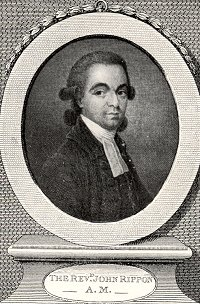
John Rippon came to Christ at age 17, in the year 1768.  He entered Bristol Baptist College in England and, upon graduation at age 21, he was called by a church whose long-serving pastor had passed away, a very respected author and preacher named John Gill.  When he came to interview, the church extended the call to him but 40 families were turned off by his youth and left to form their own congregation…eventually calling a 19-year-old man as their pastor.  John did not let the bad blood fester, even participating in the consecration of that young pastor.  He even encouraged his own congregation to contribute funds to the building of the breakaway church’s new sanctuary.  Because of Rippon’s humility and good humor, the two churches became close and worked together for the cause of Christ.

Rippon was less of a scholar than his predecessor, but an impassioned pastor to his flock with a strong burden for the lost.  His London church, called Carter Lane Baptist Church, experienced great growth during his 63-year tenure at that church, Pastor Rippon serving until his death in 1836, having baptized over 900 people.

John Rippon was an author and editor.  He edited a publication called ‘The Baptist Annual Register’ – a compilation of Baptist writings from England and North America on missions, business, associations, notices of books and articles by Baptist scholars, obituaries, and any other item he deemed of interest to English-speaking Baptists.  Baptist historians today are greatly indebted to his work.  He also wrote a selection of hymns which he intended to complement the incredible works of Isaac Watts.  His  most notable being ‘How Firm a Foundation’.

                How firm a foundation, ye saints of the Lord,
                Is laid for your faith in His excellent Word!
                What more can He say than to you He hath said,
                To you who for refuge to Jesus have fled?

In his latter years, Rippon would often pray for God to raise up a young man to lead his church to bigger and greater things.  Many people see the answer to his prayers in the man who took over his church almost 20 years after his death and later moved the place of meeting and renamed it ‘The Metropolitan Tabernacle’ – the ‘Prince of Preachers’ Charles Spurgeon, who was 19 years old at the time of his calling.  Spurgeon, later writing the history of the Metropolitan Tabernacle, characterized Rippon and his ministry as, “Beloved at home, respected abroad, and useful everywhere.”

https://en.wikipedia.org/wiki/John_Rippon

https://hymnary.org/person/Rippon_J

https://www.tribune.org/john-rippon-63-years-a-london-pastor/


Saturday, July 24, 2021

Turn Your Eyes Upon Jesus

Helen Howarth Lemmel

Helen Lemmel was born in 1863 in England, the daughter of a minister who emigrated to America when she was a child.  She was a very gifted musically and her parents paid for music teachers as often as they could.  She eventually returned to Europe as a young woman to study music in Germany where she earned a reputation as a brilliant singer.

In Europe, Helen married a wealthy European and the two came to America where they traveled widely throughout the United States, especially in the Midwest.  Helen sang in various churches – often singing hymns she wrote herself.  She later taught voice in the Moody Bible Institute in Chicago and later at the Bible Institute of Los Angeles.  She was involved in some of the musical worship of Evangelist Billy Sunday and wrote many songs and hymns for adults and children.  She even authored a Christian book for children which was widely read in her day.

In her middle-age years, Helen was diagnosed with a disease which ended up making her permanently blind.  As a result of this her husband abandoned her, leaving her destitute.  It was in dealing with this dual tragedy that a friend brought and read to her a tract written by a missionary.  This little tract contained a statement which had a profound impact on her.  It read, “So then, turn your eyes upon Him, look full into His face and you will find that the things of earth will acquire a strange new dimness.”  Helen wrote the words to her hymn Turn Your Eyes Upon Jesus that same week, stating that the words were “dictated by the Holy Spirit.”  It was first published in 1918 under the title “Heavenly Vision” and has been a staple in Christian hymnals ever since.

Helen continued to write songs of praise and worship, often calling friends over at odd hours to write down the words for her when they would come to her mind.  In her later years, numerous visitors would tell of her joy and enthusiasm.  Though in a sparse apartment and living off of government and charitable assistance Helen, when asked how she was doing, would reply, “I’m doing well in the things that count.”  She had a small plastic keyboard by her bed.  There she would play, sing, and pray.  She was known to say, “One day God is going to bless me with a great heavenly keyboard.  I can hardly wait!”

Helen died in Seattle, Washington, on November 1st, 1961, just 13 days short of her 98th birthday.

https://www.youtube.com/watch?v=682yRGibD1U

http://chrisfieldblog.com/2008/11/14/blind-helen-howarth-lemmel-turns-our-eyes

https://womenofchristianity.com/turn-your-eyes-upon-jesus-by-helen-lemmel-hymn-story/

Morgan, Robert J., Then Sings My Soul, Nelson Publishers, 2003.


Saturday, January 16, 2021

My Hope is Built on Nothing Less

My Hope is Built on Nothing Less

Edward Mote was born in 1797 in London to unbelieving parents who pretty much let him go his own way, giving him little in the way of spiritual or moral direction.  He said of his younger years, “So ignorant was I that I did not know that there was a God.”  As a teenager, he was apprenticed to a cabinet-maker who introduced Edward to the Gospel.  He responded to the Gospel, was saved, and was baptized when he was 18 years old. 

He worked in the business of cabinetry until he was 50 years of age, then entered the ministry.  He became the pastor of the local Baptist church in Horsham, West Sussex for the last 26 years of his life.  He was loved by his congregation and was offered the church parsonage as a gift.  He declined, saying he would rather have the pulpit, “and when I cease to preach Christ, then turn me out of that.”

Edward wrote some songs for his little church to use in worship.  One day, he had a thought in his head to write a hymn on the ‘gracious experience of a Christian.’  He wrote a chorus based on the Parable of the Builders and used as a chorus “On Christ the solid rock I stand, all other ground is sinking sand.”  That day he wrote the first few verses.

The fledgling song stayed on the scratch paper in his pocket for quite some time.  Later, he paid a visit to some congregants of whom the wife was critically ill.  She asked for a song and, as he didn’t have a hymnal to sing from, he pulled the scrap of paper from his pocket and sang it with the couple.  The woman asked for a copy of the song, so Edward hurried home and finished the text.  He then sent the song off to a publisher writing, “As these verses so met the dying woman’s case, so my attention to them was the more arrested.”

In the nearly two centuries since, this song has been a hymn of hope and assurance for the Church, regardless of trial and circumstance.

My hope is built on nothing less than Jesus’ blood and righteousness;
I dare not trust the sweetest frame, but wholly lean on Jesus’ name.
On Christ the solid Rock, I stand, all other ground is sinking sand, all other ground is sinking sand.

When darkness veils His lovely face, I rest on His unchanging grace;
In every high and stormy gale, my anchor holds within the veil.
On Christ the solid Rock, I stand, all other ground is sinking sand, all other ground is sinking sand.

His oath, His covenant, His blood, support me in the whelming flood
When every earthly prop gives way, He then is all my hope and stay.
On Christ the solid Rock, I stand, all other ground is sinking sand, all other ground is sinking sand.

When He shall come with trumpet sound, Oh, may I then in Him be found,
Clothed in His righteousness alone, faultless to stand before the throne!
On Christ the solid Rock, I stand, all other ground is sinking sand, all other ground is sinking sand.


https://en.wikipedia.org/wiki/Edward_Mote

https://hymnary.org/text/my_hope_is_built_on_nothing_less


Saturday, December 12, 2020

O Holy Night

O Holy Night

In 1847, a parish priest in a small town in France asked a local wine merchant named Placide Cappeau to write a poem for his church’s Christmas Eve mass.  During a hard carriage ride to Paris, Cappeau read through the Gospel of Luke and imagined himself an eyewitness to the birth of Jesus.  On that carriage ride, Cappeau wrote the words to a poem he entitled “Cantique de Noel” (Song of Christmas). 

Cappeau asked his friend, Adolphe Charles Adam, to write the music.  It was an easy feat for Adam, a trained and skilled musician, and he composed the tune with ease.  The song was performed for the congregation on Christmas Eve as planned, and it was an absolute hit!  The song quickly spread through France.

O Holy Night!  The stars are brightly shining,
It is the night of the dear Savior’s birth.
Long lay the world in sin and error pining.
‘Till He appeared and the soul felt its worth
A thrill of hope the weary world rejoices,
For yonder breaks a new and glorious morn.
Fall on your knees!
Oh, hear the angel voices!
O night divine, O night when Christ was born
O night, O holy night, O night divine!

However, leaders within the French church learned later to their horror that Cappeau had abandoned the Christian faith in favor of Socialism and that Mr Adam had always been a practicing Jew.  Neither was a believer!  Because of this, performance of the song was banned in French churches.  The French people loved it, however, and continued to sing it in private.  The song remained banned until the Franco-Prussian War in 1871, where the song was a catalyst for a ‘Christmas Eve truce’ between the armies.

The song came to the United States via a man named John S. Dwight, an abolitionist who was visiting France.  He translated the song into English, with some liberties to advocate for his cause, especially in the third verse:

Truly He taught us to love one another.
His Law is love and His Gospel is peace.
Chains shall he break, for the slave is our brother.
And in His name all oppression shall cease.
Sweet hymns of joy in grateful chorus raise we,
Let all within us praise His holy name
Christ is the Lord!
O praise His name forever!
His pow’r and glory evermore proclaim
His pow’r and glory evermore proclaim!


https://www.incourage.me/2013/12/history-of-christmas-carols.html

https://pjmedia.com/faith/jeff-sanders/2016/12/12/the-unbelievable-inspiring-story-behind-o-holy-night-n96341


Saturday, October 24, 2020

The Old Rugged Cross

 The Old Rugged Cross

George Bennard was born in Youngstown, Ohio, in 1873.  While very young, the Bennard family moved to Iowa so George’s father could work in the coal pits there.  George’s father passed away when George was only sixteen years old, and George came to faith soon after.  As a young man, George got involved in the growing Salvation Army and served, with his wife, as officers in that organization for a period of time.

Later, George joined the Methodist Episcopal Church as an evangelist.  His preaching emphasized Christian purity and godliness – and used the term “Christian holiness.”  He taught that when personal holiness (as defined in the Bible) was missing from individuals, the church lost the ability to positively impact the culture in which it lived.  George traveled extensively in his evangelistic work but tended to focus mostly in the states of New York and Michigan.

It was in the early twentieth century that the American and European churches were heavily flirting with theological liberalism, which called into question many of the fundamental doctrines of the church and, sadly, led many individuals, churches, and even entire denominations into a spiritual wasteland.  During this time, George himself seems to have been enticed by these doctrines and went through a bit of spiritual turmoil himself in struggling with this.

Rev Bennard spent much time in reflection on the Cross of Christ, and what Peter meant when he spoke of ‘sharing in the sufferings of Christ’ (I Peter 4:13).  In his reflections, he pictured in his mind a picture of the Cross on a distant hill and he resolved personally not to bow to the pressure of liberalism plaguing his church.

During this time of personal reflection, George was conducting a series of revival services and during one particular meeting, he was viciously heckled by a group of teenage boys.  In praying for them that evening in 1915 the words came to him for a song, with a basis on that mental picture of a cross standing on a lonely hill.

On a hill far away, stood an old rugged Cross; The emblem of suff'ring and shame
And I love that old Cross where the dearest and best; For a world of lost sinners was slain
 
Oh, that old rugged Cross so despised by the world; Has a wondrous attraction for me
For the dear Lamb of God, left His Glory above; To bear it to dark Calvary
 
In the old rugged Cross, stain'd with blood so divine; A wondrous beauty I see
For ’twas on that old cross Jesus suffered and died; To pardon and sanctify me
 
To the old rugged Cross, I will ever be true; Its shame and reproach gladly bear
Then He'll call me some day to my home far away; Where His glory forever I'll share
 
So I'll cherish the old rugged Cross; Till my trophies at last I lay down
I will cling to the old rugged Cross; And exchange it some day for a crown

This beloved hymn was picked up by Hymie Rodheaver and popularized by him during the Billy Sunday crusades of the early 20th century, and has been a beloved hymn ever since.  Wikipedia has a list (certainly not a comprehensive list) of performers that have recorded this hymn: Al Green, Andy Griffith, Anne Murray, Brad Paisley, Chet Atkins, George Jones, Eddy Arnold, Johnny Cash and June Carter, Ella Fitzgerald, Mahalia Jackson, Merle Haggard, Patsy Cline, Loretta Lynn, Ricky Van Shelton, Tennessee Ernie Ford, Roy Rogers and Dale Evans, The Oak Ridge Boys, The Gaither Vocal Band, The Statler Brothers, Vince Gill, Willie Nelson, Alan Jackson, George Beverly Shea, and Ronnie Milsap.

https://christianheritagefellowship.com/george-bennard-and-the-old-rugged-cross/#Introduces%20%E2%80%9CThe%20Old%20Rugged%20Cross%E2%80%9D%20(1913).BK

https://en.wikipedia.org/wiki/The_Old_Rugged_Cross


Saturday, October 10, 2020

Nearer, My God, to Thee

Sarah Flower Adams

Sarah was born in 1805, in Essex, England.  She and her sister Eliza were the only children of Benjamin Flower, a Cambridge printer and newspaper editor who was jailed at least once for what he printed.  Both daughters became gifted composers and authors.

After her mother’s death, Sarah’s father moved the family to a rural area where they numbered among their family friends the great author Robert Browning. 

Their father died in 1825, and the two young women moved in with the pastor of their church.  Eliza devoted herself to enriching the musical ministry of her church, composing hymns and playing during the services.  Sarah married an author and civil engineer, and while she wrote some hymns herself, her passions turned to acting.  Moving to the Richmond district of London to be near the larger theaters, she performed in some minor roles, then played Lady Macbeth in 1837, with rave reviews.  Frail health put a stop to her acting career soon after, so she again turned to writing hymns and poetry after moving with her husband again to be near her beloved sister Eliza.

Her Pastor approached the two sisters in 1840, frustrated that he could not find a hymn to work with his upcoming Sunday sermon, taken from the story of Jacob at Bethel – Genesis 28:20-22.  Sarah offered to write the hymn herself if Eliza would write the music.  All week long, she pored over the passage, visualizing Jacob sleeping on the ground with a rock for a pillow while dreaming of a ladder reaching to Heaven.  The following Sunday, South Place Church sang this song for the first time:

Nearer, my God, to Thee,  Nearer to Thee

E’en though it be a cross That raiseth me!

Still all my song shall be, Nearer, my God, to Thee

Nearer, my God, to Thee, Nearer to Thee!


Though like the wanderer, The sun gone down.

Darkness be over me, My rest a stone;

Yet in my dreams I’d be, Nearer, my God, to Thee

Nearer, my God, to Thee, Nearer to Thee!


There let the way appear, Steps unto Heav’n;

All that Thou sendest me, In mercy giv’n;

Angels to beckon me, Nearer, my God, to Thee

Nearer, my God, to Thee, Nearer to Thee!


Then, with my waking thoughts, Bright with Thy praise,

Out of my stone griefs, Bethel I’ll raise,

So by my woes to be, Nearer, my God, to Thee

Nearer, my God, to Thee, Nearer to Thee!


Or if, on joyful wing Cleaving the sky,

Sun, moon, and stars forgot, Upward I’ll fly,

Still all my song shall me, Nearer, my God, to Thee

Nearer, my God, to Thee, Nearer to Thee!


Eliza died in 1846, after a long bout with Tuberculosis – faithfully attended by her dear sister the entire time.  It was only near the end of Eliza’s life that Sarah began to show signs of the disease herself.  Sarah held on for nearly two years, but finally passed away in 1848 at the age of 43.

One of the survivors of the Titanic, on April 14, 1912, recalled that the band played this hymn as the great ship sank to its icy grave.


Morgan, Robert J., Then Sings My Soul, Nelson Publishing, 2003.

https://www.bartleby.com/294/124.html

https://en.wikipedia.org/wiki/Sarah_Fuller_Flower_Adams


Sunday, August 16, 2020

All Hail the Power of Jesus Name


The National Anthem of the Christian Faith

 Edward Perronet lived in the 18th century, born in England in 1726 and died in 1792.  He came to faith at an early age, due to the influence of his godly parents.  Entering the Anglican ministry, he became associated for many years with John and Charles Wesley.

Edward’s clever wit made him rather popular.  At one point, John Wesley put him on the spot and unexpectedly announced that his friend Edward was going to preach the next sermon.  Edward stood up and proclaimed that he was going to deliver the greatest sermon ever preached.  He opened his Bible to Matthew and read chapters 5, 6, and 7, The Sermon on the Mount, then sat back down.

In the November 1779 issue of The Gospel Magazine, edited by Rock of Ages author Augustus Toplady, a hymn appeared, the author labeled as ‘Anonymous’.  The first verse of the hymn was:

                All Hail the Power of Jesus’ Name!  Let angels prostrate fall;

                Bring forth the royal diadem, and crown Him Lord of all!

Alongside the hymn appeared a separate poem – the first letter of each line spelled out the name “Edward Perronet”.

This 8-stanza hymn has been called “The National Anthem of the Christian Faith”.  It has been translated into almost every language on the globe where the Christian faith is represented, and is often used to this day in evangelistic work.

Reverend E.P. Scott, late in the 18th century, traveled to India for purposes of evangelism.  He heard of a tribe of people who had never been reached with the Gospel.  He traveled alone to reach them and, nearing their territory, was suddenly confronted by a band of warriors from the tribe who all pointed their spears at his heart.  Fearing his life was at an end, he pulled out his violin, closed his eyes, and played the tune of this hymn, fully expecting to be martyred at any moment.  When he finished the song, he looked up and saw the warriors, many with tears in their eyes, and all spears lowered.  Reverend Scott had the privilege of spending two years with that tribe and seeing many of them come to faith.


Morgan, Robert J., Then Sings My Soul, Nelson Publishers, 2003.

https://www.christianity.com/church/church-history/timeline/1701-1800/perronets-national-anthem-of-christendom-11630316.html

https://www.christianmusicandhymns.com/2015/03/all-hail-power-of-jesus-name-edward.html